

An article I wrote in lockdown - June 2018
Designing with E’s. Expertise, Empathy and Ego
My mother once said to me,“Don’t ask the question, if you can’t handle the answer”. This was a piece of advice from her when I was devastated by a relationship break up, aged 15 and a half, way back when everything like that felt like the worst thing ever. The reality is that it’s hard when someone tells you something you don’t want to hear, especially when you’re vulnerable or sensitive. It hurts like hell.
But this isn’t an article about heartbreak, but more about the human condition and how that relates to User Experience in the digital world. Designing experiences, much like being in relationships is very exposing. Nobody wants to get hurt but inevitably someone does. We tend to protect what we create, whether it’s a work of art, a bond of friendship or an interface design. It’s personal to us and it matters to us, but much like the work of art, designed to be seen and appreciated, or a bond of friendship designed to be shared and nurtured or a user experience designed for the user, we have to accept that it’s not just about us. In fact just the opposite. The best experience design happens when we remember that we’re designing for someone else. In fact the end of your design is the beginning of your users’ experience, so you have to trust that you’ve produced something usable.
As User Experience designers we have the knowledge the know how and the equipment to create but if that gift is to be appreciated it has to be created with the end user in mind. So, how do we know that we’re on the right track? This is where research plays a big part. To go back to the start of this article, ‘don’t ask the question, if you can’t handle the answer’. What I mean is, if you’re designing for someone else, you should be able to hear what they say about it, not what you want to hear. Why is this such an issue and what should your research be weighing up to create that criteria for success? It’s a question of designing with E’s, three E’s in fact:
The Designing with E’s model
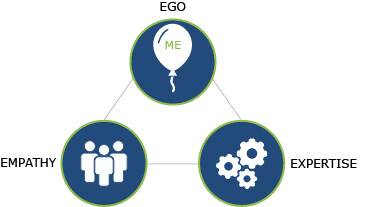
The first is expertise. This is the making mode, where you bring your tools and knowledge to produce an experience that is rooted in what your target audience wants and your ability to make it happen. You’re the expert in your field. Be it creating a design, writing copy or defining the user experience, you know what to create based on the tools you have.
The second is empathy. This is the part that allows you to walk in the shoes of someone else. It’s a listening and an understanding mode, to be in that person’s situation. The ability to relate to someone else’s feelings and experiences by understanding that person’s perspective, empathy helps us develop deep levels of rapport and trust with others.
The third is ego. This is the creative mode, because adding a bit of ego can be quite empowering. It allows us to feel confident to be bold, adventurous and to consider to drive through new ideas, products and services. So adding some ego to your expertise can really help achieve a great experience to a design and get it where it needs to be. However, too much ego and you start pulling away from others, you become oblivious to why you were doing it in the first place, for your end user and the empathy you originally applied.
As a user researcher I’ve heard a lot of reasons to either not include the research phase or to not consider the result from the user testing sessions. “It’s not our problem if they don’t get it, they’re not our target audience anyway”, “we’ll test it but don’t have time to make any changes before it goes live, so we’ll change it later”, “it’s only the opinion of 5 people” are just a few examples. Anyone could be your audience, things hardly ever get prioritised for changes once it’s been put live and 5 people is more than enough to start seeing if a concept makes sense or if a design is usable and at least you’ve asked someone for feedback.
If you ignore the research part, you’re not looking at your design from your users perspective, you’re not imagining how it would be for them. So delivering a design that works best for your users means getting a balance between expertise, empathy and ego. The three will enable you to achieve design excellence for your end user. And I don’t just mean going through the motions of research, but by really understanding the emotions and how they interplay, that can make the difference between brilliantly effective design and disengaging your audience. The value of user testing will bring you the kind of insights you’ll need to make sure your User Experience design goes smoothly and successfully.
Online is an unassisted channel, so your audience are on their own with your design. In other channels you can gauge what people are feeling through tone of voice or body language and you can adapt your approach accordingly. Your website needs to work for your user, not just for your business. If usability testing has smoothed out the kinks in the design, don’t ignore those details, however small. Sometimes the smallest issue can have the biggest impact on users being able to use your design and use it easily and therefore happily. Getting users feedback is not a luxury in User Experience design, it’s a necessity and it gives you a key ingredient, empathy.
What happens when you lose your sweet-spot and you let any of the E’s become greater than the others?
For example: What happens when the ego becomes too strong?
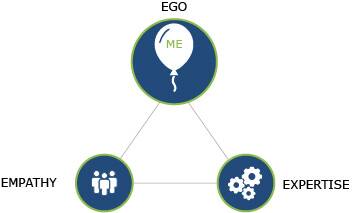
Many of us will know that looking at and understanding human behaviour can be incredibly complicated and this can be from both perspectives, so not just focusing on your user but focusing on yourself. Humans will be humans and have a natural need to fit in, to be liked or accepted. So you want to feel good about yourself and sometimes it’s a big ask on your ego to admit you don’t know everything. Obviously you will have initial assumptions because of your expertise and experience, but it’s ok to not know everything, it’s ok to ask for understanding and keep asking until you get it. If you’re not asking or listening to your audience, then I guess I’d ask the question why not? Increasing your self awareness to understand what’s stopping you from asking the questions, this will allow you to keep the ego part equal to empathy for your users and the expertise needed to provide the experience.
And the 3 E’s model doesn’t just work in the design process, but also for review and development. It’s a great model to ensure that those who are reviewing the work aren’t bringing too much of their own ego, too much of their proximity to the audience or too much of their knowledge and experience in deciding whether something will work or not. As a business you need to be mindful that you don’t create an internal ‘deadlock’. When someone in a higher position outside of the digital process simply says “I don’t like it, change it”, or when the design phase gets handed over to be built and developed, the team doesn’t make changes that become detrimental to the users experience.
Find the sweet-spot for ‘Excellence’ and a successful design
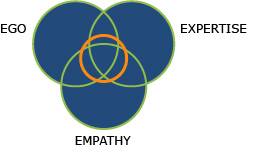
Being mindful of situations when the ego overpowers both expertise and empathy can help to prevent any conflict between them. Don’t be complacent and design for yourself, designing for your users will help develop deep levels of rapport and ultimately create trust in what you offer them. If your users don’t trust your website, design or brand they won’t buy your product or service and conversion rates will be low. So when you don’t design with E’s, you really don’t want to find yourself as the one responsible for the ‘F’ in ‘Failure’…
Written by Liz Nightingale, User Research Manager, Web Psychologist